You’re Not Secure Until Samsung Knox Secures You: Understanding the Real Cost of Cybercrime in Malaysia
August 24, 2026Cybercrime is becoming harder to spot, and for many Malaysians, the smartphone is the first place a scam begins.
From fake identities and social engineering to increasingly sophisticated AI-powered scams, criminals are finding new ways to convince people to click, download, share information or hand over their money. This makes smartphone security more important than ever, particularly as our devices become central to banking, communication, shopping, work and everyday life.
Malaysia has seen a significant increase in online scam cases. Inspector-General of Police Tan Sri Mohd Khalid Ismail noted that 66,204 cases were recorded during the first half of 2026, representing an 87% increase compared with the same period a year earlier.
The financial impact is equally concerning. Victims lost RM2.97 billion in 2025, an increase of RM1.40 billion from the previous year, with phone scams continuing to be among the frequently reported types of cybercrime.
For consumers, the question is no longer simply whether they can recognise a scam. The bigger question is whether their devices are equipped to help protect them when something slips through.
Security Starts With the Device
This is where Samsung Knox comes into the picture.
Samsung’s Knox security platform is built into its devices and is designed to provide protection at the device level, helping reduce the need for users to identify every potential threat on their own.
One example is Samsung Message Guard, which is designed to detect and isolate potentially harmful content received through messages. The feature helps protect devices from malicious files that could attempt to exploit vulnerabilities.
It also works alongside Google Play Protect, which scans applications for potentially harmful software.
Samsung Knox also includes technologies that monitor device activity and help identify suspicious behaviour. Real-time Kernel Protection, for example, monitors activity at the system level, while Samsung Defeat Exploit (DEFEX) is designed to restrict unusual application behaviour.
Security doesn’t stop at launch either. Selected Samsung devices are eligible for up to seven years of security updates, helping extend protection as new threats emerge.
Bringing Knox Protection to the Galaxy Z Series
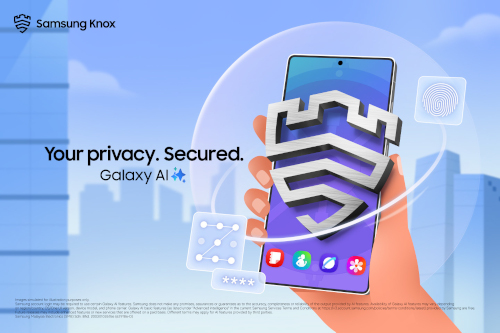
Samsung is also extending this security approach to its latest foldable smartphones, including the Galaxy Z Fold8 Ultra, Galaxy Z Fold8 and Galaxy Z Flip8.
Samsung Knox is enabled by default on these devices from the moment they are switched on, providing security protection as part of the overall device experience rather than something users need to install separately.
The new Galaxy Z Series also introduces Knox Vault, a tamper-resistant hardware security environment designed to isolate sensitive information such as passwords, biometric data and other credentials from the rest of the device.
Another layer comes through Knox Enhanced Encrypted Protection (KEEP), which provides dedicated encrypted storage for individual applications.
Running on One UI 9, the new Galaxy Z Series also features Privacy Alerts, which can notify users about suspicious background permission requests.
For users who rely heavily on their smartphones, these layers of protection are increasingly important as personal information and digital services become more connected.
Cybersecurity Is Also a Business Problem
The impact of cybercrime doesn’t stop with individual consumers.
Businesses are facing increasingly sophisticated attacks, with Business Email Compromise becoming a major concern for organisations. Malaysian organisations reportedly lost more than RM7.5 million to Business Email Compromise incidents between 2023 and the first half of 2025.
Businesses also recorded 190,556 exploit attempts targeting organisations during the first half of 2025, according to data reported by Bernama citing Kaspersky findings.
For companies managing hundreds or even thousands of smartphones and other connected devices, protecting each user is only part of the challenge. Organisations need visibility and control across their entire device fleet.
Samsung Knox is designed to address this through hardware-backed security, centralised management and tools that allow IT teams to monitor devices and manage security policies at scale.
Through Knox Suite, organisations can manage devices, monitor their health, deploy updates and strengthen security controls across large fleets.
Tools such as Knox Asset Intelligence Security Center provide greater visibility into device performance and security conditions, while Knox E-FOTA allows IT administrators to manage operating system updates more systematically.
Samsung Knox also supports a Zero Trust security approach, where access is continuously verified rather than automatically trusted simply because a device or user has previously been approved.
For organisations using platforms such as Microsoft Intune, Samsung also provides hardware-backed Knox On-Device Attestation to help verify device security during mobile application management.
Security Can No Longer Be an Afterthought
The reality is that cyber threats are evolving alongside the technology we use every day.
Scammers no longer rely solely on obvious fake messages or suspicious-looking emails. Social engineering, impersonation and AI-assisted attacks can make scams increasingly convincing, meaning even careful users can find themselves facing sophisticated threats.
That is why smartphone security needs to go beyond simply asking users to be more careful.
Samsung’s approach with Knox is to build multiple layers of protection directly into the device, helping identify suspicious behaviour, protect sensitive information and provide security controls that operate in the background.
For consumers, that can mean an additional layer of protection around the smartphone that has become an essential part of everyday life.
For businesses, it means security can extend across an entire fleet of devices rather than stopping at the individual employee.
Ultimately, the message is straightforward: security should begin with the device itself.
As Malaysians continue to spend more of their lives online, having a secure smartphone is no longer just about protecting a device. It is about protecting the information, identities and digital lives connected to it.